In this article:
What Is The Second Stage of Labour?
The second stage starts once your cervix is fully dilated until your baby is delivered. The second stage consists of two phases: the passive phase, wherein your baby moves downward even without you experiencing the urge to push, and the active phase, wherein you push your baby downwards during each contraction. It usually lasts for about twenty minutes up to a few hours, but it takes more time for women who are first-time mothers and those who have epidurals.What Is the Difference Between Coached Pushing vs Spontaneous Pushing?
There are two main ways that doctors help you deliver your baby, and which method you choose depends on your preferences, your doctor's advice and whether you had an epidural.Spontaneous birth means going along with the natural urges of your body. That means you give birth when you feel a natural urge to push during a contraction and relax until your body tells you otherwise. This is possible if you do not have an epidural, or if you can still feel the pressure despite having one.
Coached pushing means your doctor tells you when to push and how many times to push during delivery. This is usually done if your urge to push is diminished because of an epidural.
No one can say which method is better, as both are correct; it simply depends on your body and your birth experience.
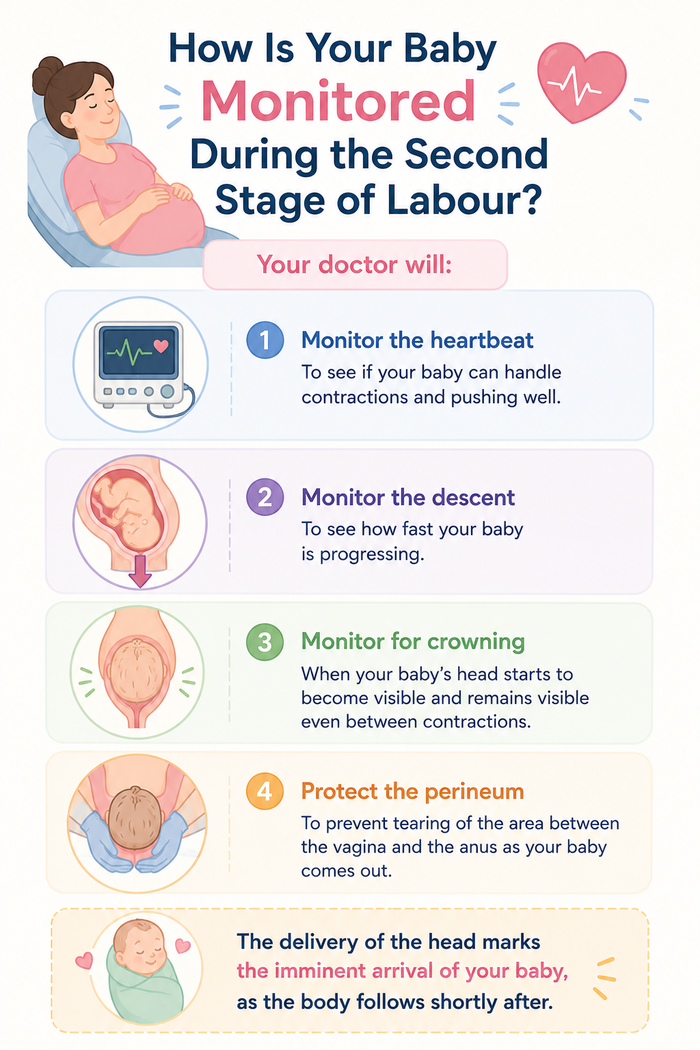
How Is Your Baby Monitored During This Stage?
Since your baby is travelling through the birth canal, monitoring will go on during this stage as well. Your doctor is going to:- Monitor the heartbeat of your baby to see if they can handle the contraction and pushing phase well
- Monitor the descent of your baby to see how fast they are progressing
- Monitor for crowning, which is when your baby's head starts to become visible and remains visible even between contractions
- Protect the perineum area, which is the area between the vagina and the anus, to prevent the area from getting torn when your baby comes out of your vagina
What Can Be Done If Your Baby Needs Some Extra Help?
Sometimes, despite all your efforts, there is a possibility that your baby might require some additional help to be delivered, especially if you have been pushing for some time or if your baby seems to be distressed. In such situations, you could go for the following techniques:- An episiotomy: An episiotomy involves making a cut in the vagina to widen the opening, and it is performed under local anaesthesia if you do not have an epidural yet.
- Forceps delivery: It involves using curved metal instruments to assist in delivering your baby's head while you are contracting.
- Vacuum-assisted delivery: This procedure involves using a soft cup that is attached to your baby's head through suction and helps to deliver the baby while you are pushing.
When Should You Talk to Your Doctor?
Your doctor will be closely involved throughout this stage, but it always helps to speak up if you notice any of the following:- If you become too tired to push on properly
- If you cannot figure out how to push
- If you start feeling panicky, scared, or need extra reassurance
- If you wonder why a certain intervention is needed
- If anything seems different or worrisome to you
This is the second stage of labour, which calls for some real effort from you; it is, however, the phase which finally brings you to the point you have been waiting for.
Whether you’re pregnant, a new mom, or navigating postpartum, you don’t have to do it alone. Join our support group to connect, share, and support one another.
FAQs on Giving Birth: The Second Stage of Labour Explained
- Will I need an episiotomy or any assisted delivery?
No, many women do not require them. They are only considered if your doctor feels that they will actually help you and your baby. - How will my baby be monitored while I am pushing?
The heart rate of your baby will be checked on a regular basis, along with monitoring their progress during this phase. - Is the episiotomy painful?
It will be performed using a local anaesthetic if you have not had one yet, so the cut itself will not be painful, but the healing process might be.