What she had was HELLP syndrome, a rare but life-threatening pregnancy complication that looks so much like everyday discomfort, and by the time they realise something is seriously wrong, the window to act safely may be narrowing by the hour.
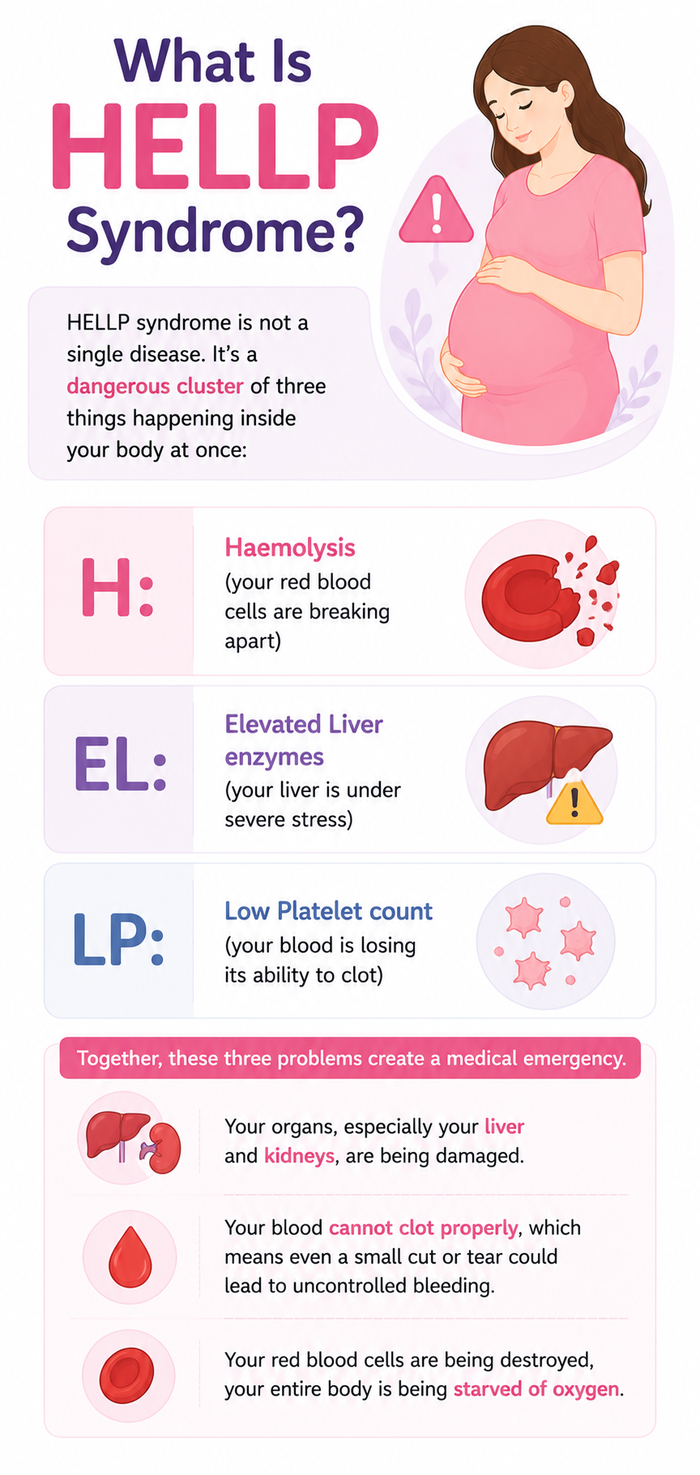
What Is HELLP Syndrome?
HELLP syndrome is not a single disease. It's a dangerous cluster of three things happening inside your body at once:- H: Haemolysis (your red blood cells are breaking apart)
- EL: Elevated Liver enzymes (your liver is under severe stress)
- LP: Low Platelet count (your blood is losing its ability to clot)
HELLP syndrome affects roughly 0.5% to 0.9% of all pregnancies, which is about 1 in every 150 pregnant women. It sounds rare until you realise how many millions of pregnancies happen every year. And crucially, it can develop within hours and escalate to organ failure, stroke, or maternal death if missed.
Who Gets HELLP Syndrome,nbsp; and Who Is Most at Risk?
HELLP syndrome does not always follow a pattern. It can strike women with no prior warning or obvious risk factors.You may be at higher risk if you:
- Have been diagnosed with preeclampsia (high blood pressure in pregnancy), HELLP develops in around 10–20% of preeclampsia cases
- Had HELLP in a previous pregnancy (the recurrence risk is around 3–27%)
- Are carrying multiples (twins, triplets)
- Are over 25, though younger women are affected too
- Have a history of high blood pressure or autoimmune conditions
- Are in your third trimester, most cases appear between weeks 27 and 37
But here is what surprises many people: Based on the American Academy of Family Physicians, HELLP Syndrome presents postpartum in 31% of patients, with onset typically within the first 48 hours after delivery.
This means the danger does not necessarily end the moment your baby is born. Postpartum women need to remain vigilant, too.
The Symptoms That Are Easy to Miss
HELLP syndrome does not announce itself with dramatic, unmistakable signs. It sneaks in wearing the disguise of ordinary pregnancy discomfort. Here is what to watch for:Early warning signs (often dismissed):
- Pain or tenderness in the upper right abdomen, or pain that radiates to the shoulder or upper back
- Persistent headache that doesn't improve with rest or paracetamol
- Nausea and vomiting, especially if it suddenly returns in the third trimester
- Feeling unwell, like you're "coming down with something."
- Fatigue that feels deeper than usual pregnancy tiredness
- Slight visual changes, blurring, seeing spots, or flashing lights
- Swelling that is sudden and severe, especially in the face and hands
- Yellowing of the skin or eyes (jaundice)
- Significant weight gain over a very short period
- Dark or tea-coloured urine
- Bleeding from unexpected places, gums, nose, or from small cuts that won't stop
How Is HELLP Syndrome Diagnosed?
Your doctor cannot diagnose HELLP by looking at you or checking your blood pressure alone. It requires blood tests, and in some cases, the results can change rapidly within hours.The key blood tests include:
| Complete Blood Count (CBC) | Platelet levels | Platelets dangerously low |
| Liver Function Tests | AST and ALT enzyme levels | Both significantly elevated |
| Peripheral Blood Smear | Red blood cell shape under the microscope | Fragmented, destroyed cells |
| Lactate Dehydrogenase (LDH) | Cell destruction marker | Elevated |
| Bilirubin | Byproduct of red blood cell breakdown | Elevated, may cause jaundice |
Doctors use a classification system called the Mississippi Classification to grade HELLP severity based on platelet counts, Class I being the most severe. This helps guide the speed and type of treatment needed.
What Happens If HELLP Is Left Untreated?
Untreated HELLP syndrome can be fatal for both the mother and the baby.Possible complications include:
- Liver rupture: One of the most serious complications of HELLP. The liver can rupture due to a blood clot (hematoma) forming inside it. This is a surgical emergency with a very high mortality rate.
- Placental abruption: The placenta separates from the uterine wall prematurely, cutting off the baby's oxygen and nutrients.
- Acute kidney failure: Toxins released from destroyed red blood cells clog the kidneys' tiny filters. When they shut down, the body can't remove waste or balance fluids. Temporary dialysis may be needed, though most women regain kidney function with timely treatment.
- Pulmonary oedema: Damaged blood vessels leak fluid into the lungs, making it increasingly hard to breathe. Women may feel sudden shortness of breath, chest tightness, or a sense of suffocation. It requires urgent treatment with oxygen and medications to draw out the excess fluid; if not addressed quickly, it can lead to respiratory failure.
- Disseminated Intravascular Coagulation (DIC): A severe clotting disorder where the blood simultaneously clots in tiny vessels and fails to clot where needed. DIC occurs in roughly 1.7% of HELLP cases,but when it develops, it dramatically accelerates maternal deterioration.
- Stroke: Severely low platelets combined with high blood pressure put the brain at serious risk; either a vessel bursts or a clot blocks blood flow. Both types can cause permanent disability and stroke. Cerebral haemorrhage accounts for 45% of HELLP-related maternal deaths, making it the single leading cause.
- Preterm birth and neonatal complications: Since delivery is the only cure, many babies arrive weeks early and may need NICU care for breathing, feeding, and temperature regulation. With modern neonatal care and pre-delivery steroid injections to mature the baby's lungs, outcomes are significantly better than they once were.
According to a large population-based study, women with HELLP syndrome have a 10-fold higher maternal mortality compared to those without it.
The maternal mortality rate for untreated or delayed HELLP ranges from 1% to as high as 25%, depending on severity and access to care. Research published in puts the mortality rate at 0–24%, with a perinatal death rate of up to 37%. With early, appropriate treatment at a capable facility, outcomes improve significantly.
Treatment: What Will Doctors Do?
There is no medication that "cures" HELLP syndrome in the way an antibiotic cures an infection. The only definitive treatment is delivering the baby.Here is what the medical team will typically do:
- Immediate stabilisation: Corticosteroids (such as betamethasone or dexamethasone) are given to speed up foetal lung development if the baby is preterm, and they also help improve platelet counts temporarily in the mother. Blood pressure medications are used to prevent stroke. Magnesium sulfate may be administered to prevent seizures.
- Blood product transfusions: If platelet counts are critically low or there is significant bleeding, transfusions of platelets, fresh frozen plasma, or packed red blood cells may be needed.
- Delivery: If you are at 34 weeks or beyond, delivery, either vaginal or by caesarean section, will happen as soon as the mother is stabilised. If you are earlier than 34 weeks, doctors will try to stabilise the situation and give steroids for 24–48 hours before delivery, but only if it is safe to wait. In severe or rapidly worsening cases, delivery happens immediately regardless of gestational age.
Life After HELLP: What to Expect
The majority of women recover fully from HELLP syndrome, though recovery can take weeks to months, depending on severity.What recovery might involve:
- Blood pressure monitoring, sometimes requiring medication for weeks or months
- Liver function monitoring through repeated blood tests
- Follow-up with a specialist (maternal-foetal medicine or a high-risk obstetrician)
- Mental health support, a diagnosis like HELLP can be genuinely traumatic, and anxiety about future pregnancies is common
If you want to get pregnant again after HELLP, talk honestly with a specialist. Most women can have subsequent pregnancies, but they require careful planning, early prenatal monitoring, and sometimes low-dose aspirin from early pregnancy to reduce the risk of recurrence.
Pregnancy is already a season of uncertainty, of constant changes, new sensations, and the quiet worry that comes with growing a life. But knowing about HELLP is not about fear. It is about being prepared. It is about being the kind of advocate for yourself that every pregnant woman deserves to be.
Whether you’re pregnant, a new mom, or navigating postpartum, you don’t have to do it alone. Join our support group to connect, share, and support one another.
FAQs on HELLP Syndrome: The Pregnancy Complication That Can Go From Fine to Critical in Hours
- Can HELLP syndrome develop with normal blood pressure?
Yes, HELLP syndrome frequently occurs alongside preeclampsia (which involves high blood pressure); up to 15–20% of HELLP cases present with normal or only mildly elevated blood pressure. This is one of the reasons it can be missed. - How quickly can HELLP syndrome develop?
Extremely quickly. Some women go from mild, vague symptoms to a critical condition within 24 to 48 hours. In rare cases, deterioration can happen even faster. This is why any concerning symptom combination, headache, upper right abdominal pain, nausea, and visual changes should prompt immediate medical evaluation rather than waiting. - Does HELLP syndrome affect the baby?
Yes, it can. Because HELLP often leads to early delivery, premature birth is one of the most common consequences for the baby. Premature infants may need care in a neonatal intensive care unit (NICU). Placental abruption, which can occur with HELLP, is also dangerous for the baby.