In this article:
Knowing about different variations and the way water breaks will make you well-prepared for anything that might happen during delivery.
What Does Water Breaking Mean?
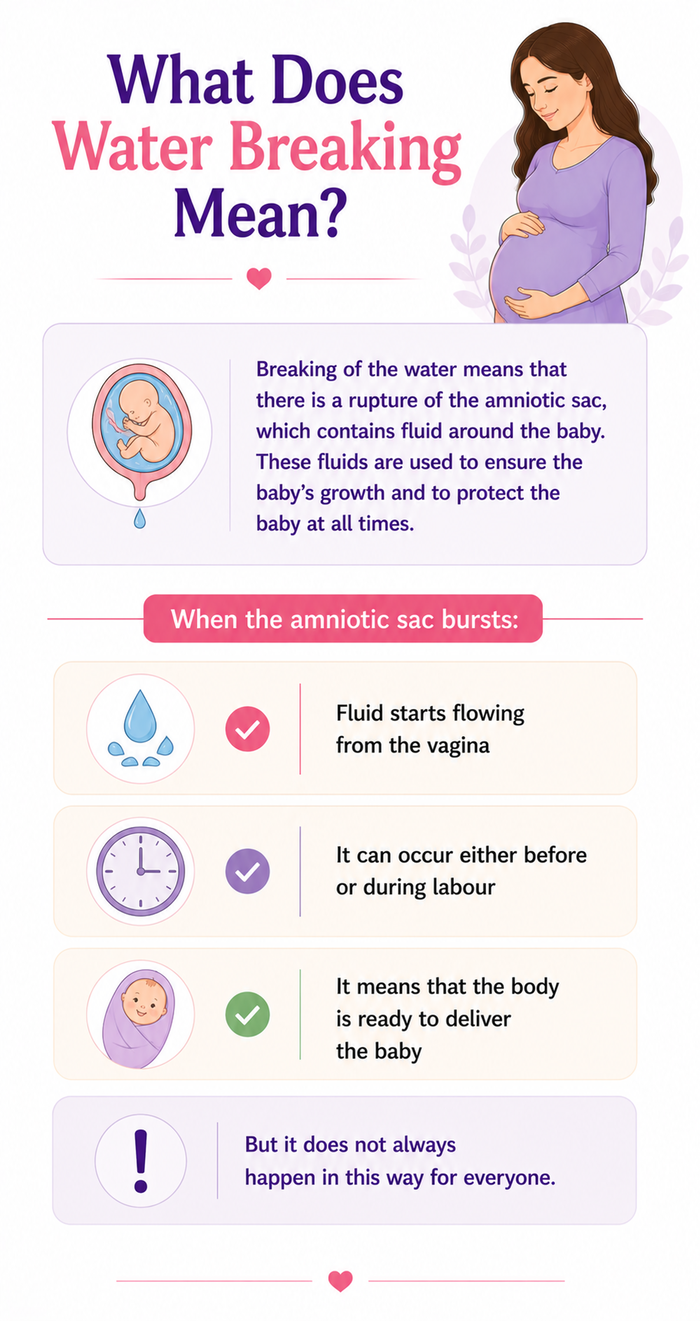
Water breaking means that there is a rupture of the amniotic sac, which contains fluid around the baby. These fluids are used to ensure the baby’s growth and to protect the baby at all times.
When the amniotic sac bursts:
- Fluid starts flowing from the vagina
- It can occur either before or during labour
- It means that the body is ready to deliver the baby
But it does not always happen in this way for everyone.
How it Feels in Real Life
While the abrupt release of water portrayed in movies might not always occur, some women experience it more gently.
- Some report a gradual flow of fluid
- Others find themselves experiencing continuous wetness
- A small number of women might experience an immediate gush of water
This fluid tends to be colourless or a very light shade and also carries a faint odour. This similarity to urine makes women uncertain about their situation.
When Does Water Breaking Occur?
The rupture of the amniotic fluid sac can take place at various stages; they are all completely normal:
- Before starting the labour process
- During the labour process
- Near the delivery time
Amniotic sac rupture rarely occurs at home. In most cases, it takes place normally during delivery with professional assistance.
Signs That Help You Identify It
Detecting water breaking can be made simple by focusing on specific clues:
- The leakage will be constant and not intermittent
- There is no foul odour characteristic of urine
- Movement may make the discharge more profuse
- There could be a warm feeling as the fluid comes out
It will be useful to remain calm and composed and watch out for these physical signs.
Things to Do When Your Water Breaks
Following certain precautions can help you handle the situation easily. These include the following:
- Record the time at which the fluid began leaking
- Check the colour and quantity of the fluid coming out
- Place a clean pad to prevent the flow of liquid
- Call your doctor or healthcare professional immediately
Common Myths vs. Reality
Several misconceptions about water breaking stem from media depictions. Recognising the difference can increase your self-confidence.
Myth 1: Water breaking always occurs before labour begins
Fact: Water breaking frequently takes place during labour
Myth 2: Water breaking always occurs in one big gush
Fact: Slow trickling is a more typical occurrence
Myth 3: Labour starts right away once the water breaks
Fact: Labour begins slowly and gradually
Importance of Knowing Facts About Water Breaking in Real Life
Knowing what it feels like for your water to break makes you prepared when going into childbirth.
- It eliminates unnecessary fear and worries
- It enables you to make well-informed decisions
- It also encourages you to communicate well with your health practitioners
The actual event of water breaking, however, is usually quiet and gradual, not spectacular like in films. All experiences are different, and recognising that will make women feel better equipped for what lies ahead.
Knowing how things really are in advance will make women react calmly when the moment comes because of the confidence they have about the whole process.
Whether you’re pregnant, a new mom, or navigating postpartum, you don’t have to do it alone. Join our support group to connect, share, and support one another.
FAQs on The Truth About Water Breaking: What the Movies Get Wrong
- Can water be broken without contractions?
Water can break even without contractions. It may or may not lead to labour, depending on how prepared the body is. - How can I differentiate between water breaking and urine?
Water usually comes out continuously and doesn't have the smell associated with urine. However, one can consult a physician to be certain. - Do I need to head for the hospital after my waters break?
You should consult your physician before going to the hospital. They will give the best advice, taking into consideration various factors.