
In order to find out more about the due date and what can be expected from this time onwards, we got in touch with Dr Payal Chaudhary, Senior Consultant, Department of Obstetrics & Gynaecology, Rosewalk Healthcare at Rainbow Hospital.
What Does a Due Date Actually Mean?
According to Dr Chaudhary, your pregnancy due date sounds like a strict deadline, but in reality it is the expected date of delivery. It is a very good estimate which allows you and your doctor to plan the future. It does not tell you about the exact date of birth of your child.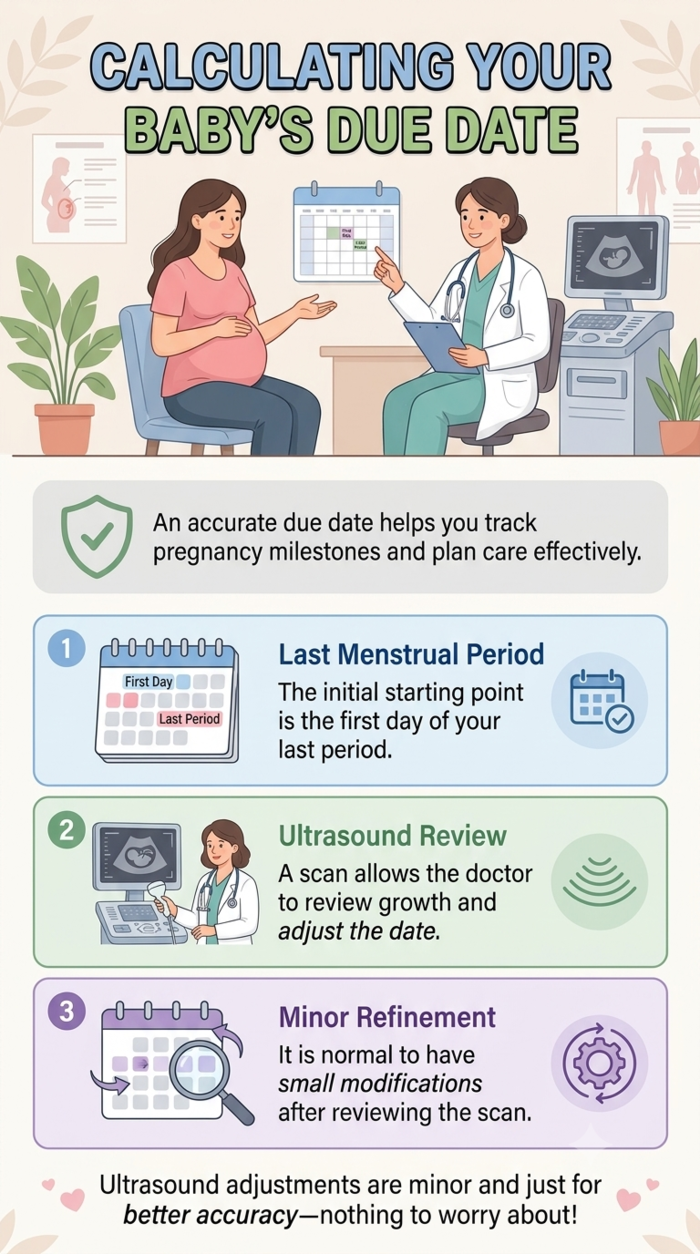
How Is the Due Date Calculated?
It is normally estimated from the first day of your last menstrual period and may be modified depending on an ultrasound, especially at the beginning of the pregnancy. Here are the key stages of calculating the expected due date:- The starting point is the first day of your last menstrual period
- Reviewing an ultrasound test will allow adjusting the date
- It is possible to modify the date a little bit after reviewing the ultrasound results
How Often Do Babies Arrive on the Due Date?
According to Dr Chaudhary, only a minority of infants are actually born on the actual due date. Infants tend to arrive in a certain period surrounding their due date and not exactly on that particular day.This implies that a baby born just a few days before or after the due date is very normal. It means that the due date should be seen as the middle point of that window.
What Is Full Term Pregnancy?
Full-term pregnancy usually occurs between 37 weeks and 40 weeks and 6 days. This allows for a sufficient and healthy window for the birth of the infant.A due date is a guide, not a deadline.
Why Is It Sometimes That Babies Are Not Born on Their Due Date?
The occurrence of labour is affected by various aspects. According to Dr Chaudhary, some of these are:- Your well-being: The well-being of the mother plays a role.
- Baby development: Every baby develops at their own pace.
- Experience: Previous deliveries can affect labour.
- Biological uniqueness: Each body operates on its own schedule.
Is Crossing the Due Date an Indication That There Is a Problem?
No. Crossing the due date is not always an indication that there is a problem. Many times, your baby just needs a few extra days.As time passes after the due date, your doctor might decide that you need closer monitoring. That will enable them to:
- Monitor your baby and check your baby's condition
- Decide if you need any kind of intervention
Where Should Your Concentration Be Rather?
According to Dr Chaudhary, you should not worry too much about delivery on any particular date. The emphasis should be placed on regular pregnancy care and adherence to the doctor's recommendations as the pregnancy develops.Each visit will give your doctor more information about your health as well as that of your baby and will also allow you to raise concerns. Here are the ways to get the most out of your visits:
- Have all your appointments: Regular visits allow your doctor to follow up on your development.
- Make notes of your questions: Write down your questions on your phone before visiting your doctor.
- Express your concerns: Share with your doctor all your concerns, even if they seem insignificant.
- Adhere to the provided recommendations: Your doctor's recommendations are designed specifically for you.
How Can You Make the Waiting Days More Bearable?
Waiting is never an easy task, especially when all your relatives keep pestering you, "Any news?" But some suggestions may help:- Have a nap and relax your body.
- Keep your hospital bag ready. Put it in an easily accessible place.
- Do things that make you happy. Do some reading, cooking, or listening to music.
- Talk about the situation with your husband or other members of your family.
- Have the contact number of your doctor and the address of the hospital with you.
When Should You See a Doctor?
If any of the following symptoms occur, consult your doctor:- In case of contractions that are occurring on a regular basis and are becoming more intense.
- If your water breaks or leaking continues consistently.
- If vaginal bleeding occurs.
- If there is a decrease in the baby’s movements.
- If you have a severe headache, blurred vision, or sudden swelling occurs.
- If the due date is past and there is no prenatal visit planned.
- If things do not seem normal to you.
The due date is a great estimate, but not an assurance. The majority of babies are born in a range of dates close to it, and a pregnancy of full term lasts from 37 weeks to 40 weeks and 6 days. With good prenatal care and consultations with your doctor, your days of waiting will become more patient.
Whether you’re pregnant, a new mom, or navigating postpartum, you don’t have to do it alone. Join our support group to connect, share, and support one another.
FAQs on What Does “Due Date” Really Mean, and How Many Babies Arrive on Time?
- Can the due date be modified by the ultrasound result?
Yes. The due date can be adjusted based on the results of the ultrasound if the development stage of the fetus differs, particularly during the initial stages of pregnancy. Such adjustment can only improve accuracy. - If my due date is over and there’s no indication that labour has started, what should I do?
Maintain regular communication with your doctor, and in most cases, you will be scheduled for additional appointments. - Can my due date change?
Yes. If your last menstrual period date cannot be determined and you have irregular cycles, your doctor can change the date using an ultrasound scan.