What Happens in the First 24 Hours of Labour?
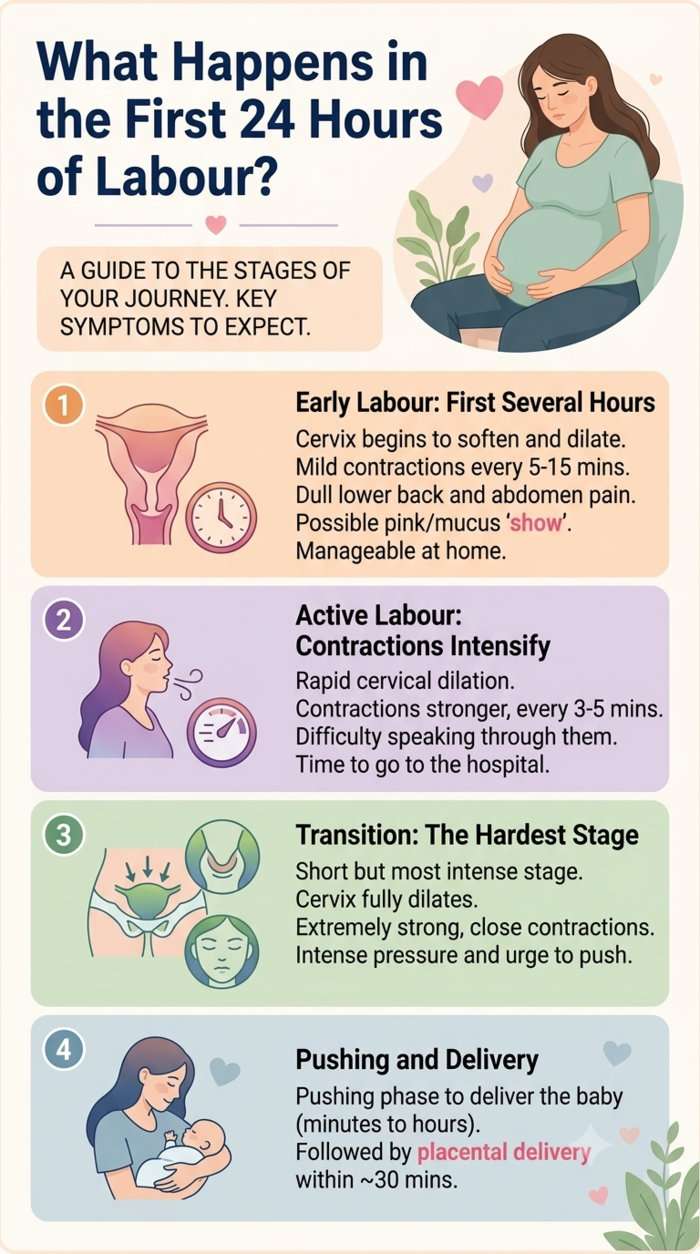
Early Labour: The First Several HoursEarly labour is the longest stage of the labour period, typically lasting six to twelve hours, or even longer for first-time mothers. It is at this point that your cervix starts to soften, dilate, and open up.
In the early labour, you will most likely experience:
- Mild contractions occurring once every 5 to 15 minutes and lasting for 30 to 90 seconds
- Dull pain in your lower back and abdomen
- Discharge which can either be pink, red, or have a mucus appearance, and is also referred to as a “show”
- Contractions that are mild enough to be bearable to the point that you can speak through them
Active Labour: Contractions Intensify
When early labour moves into active labour, contractions get more frequent, intense and last for longer. This stage normally takes about 4 to 8 hours for women who have never given birth before.
In active labour, you will experience:
- Contractions occurring at intervals of 3 to 5 minutes each, each lasting 45 to 60 seconds
- Continued dilation of your cervix more rapidly than it did earlier
- Increased strength making it difficult to talk during contractions
- Greater concentration required in active labour
Transition: The Hardest Stage
Transition is the shortest but possibly the most difficult period during the first stage of labour. It normally takes only minutes to a few hours before you complete dilation of your cervix.
Some of the symptoms that mark this stage include:
- Extremely strong contractions occurring very close together
- Pressure in the lower back region and pelvic region
- An urge to push due to the downward movement of the baby
Pushing and Delivery
After your cervix becomes completely dilated, your labour enters its second phase, and here, you will start pushing to deliver your baby down through the birth canal. It can take you from 20 minutes to a couple of hours to complete this phase, which can take a little more time if it is your first delivery, or if you have an epidural.
Immediately after the delivery of your baby, your labour will enter the third phase, where you will deliver your placenta. This will be completed in about half an hour, and you might feel some contractions or need a little bit of help from your doctor.
When you deliver your baby and your placenta, your doctors will monitor you for a couple of hours. This is known as the fourth phase of your labour, and it starts your post-delivery recovery.
When Should You Contact Your Doctor?
Your doctor will be watching your development closely when you get to the hospital, but until then, and if you start feeling some of the following signs while at home in early labour, you can consider contacting them:- Your contractions have turned into a regular process and occur every 5 minutes or so
- Your water broke either in a rush or drop by drop
- You have noticed some bleeding instead of usual discharge
- Your baby's movements seem to be reduced compared to before
- Your pregnancy is less than 37 weeks, and you feel that you are in labour
- You feel unusually unwell, dizzy, or just unsure of what is happening to you
Every labour is unique, and the above timeline is just an approximation rather than something set in stone. Try to be patient, get help from your family and friends, and remember that your medical staff is there to assist you with all the stages of your pregnancy until you give birth and after.
Whether you’re pregnant, a new mom, or navigating postpartum, you don’t have to do it alone. Join our support group to connect, share, and support one another.
FAQs on What Happens In the First 24 Hours of Labour?
- Does labour always take 24 hours?
Not really. There is significant individual variation in terms of how long labour lasts. First-time mothers tend to have labour that lasts from 12 to 24 hours, but some women may have shorter or longer labour periods. - Is labour quicker for second and third births?
Usually yes. Labour is generally quicker for women who have had children previously, taking about six to twelve hours. - How do I know when to go to the hospital during my labour?
Normally, women are recommended to go to the hospital when their contractions become steady, lasting about a minute, every five minutes.