For accurate, doctor-verified information, we reached out to Dr Rajat Grover, Senior Consultant – Paediatrician and Neonatologist at Cloudnine Group of Hospitals, Patparganj.
What Is Hand Regard in Babies?
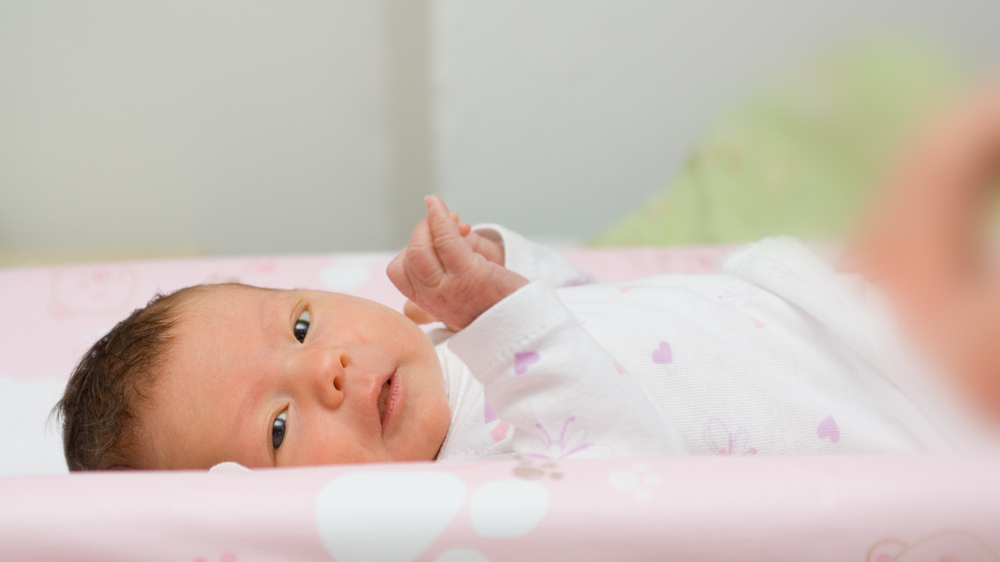
Hand regard in babies is the developmental behaviour of looking at their own hands and observing how they move. Infants gradually discover that their hands belong to them and that moving their fingers can change what they see. The baby sees the hand move and feels it move at the same time. This reflects developing visual attention, body awareness, and coordination.Researchers describe hand regard as a bridge between early self-exploration and purposeful reaching.
As vision and coordination improve, babies become increasingly aware that these moving hands belong to them.It is an important part of early visual, motor, and sensory development.
When Do Babies Discover Their Hands?
| Age | What you may notice |
| Birth to 1 month | Hands are mostly clenched. Newborns see clearly only about 8 to 12 inches away. |
| 2 months | Hand regard begins. Hands open briefly, and babies may glance at them. |
| 3 months | Hand regard is most frequent. Hands often meet at the midline. The grasp reflex weakens. |
| 4 months | Baby looks at their hands with interest and brings them to the mouth. Swiping at toys begins. |
| 5 to 6 months | Hand regard fades. Reaching becomes visually guided. Babies increasingly try to reach for nearby toys, hold objects placed in their hands, and explore safe items by touching and mouthing them. |
Why Is Hand Regard Important for Baby Development?
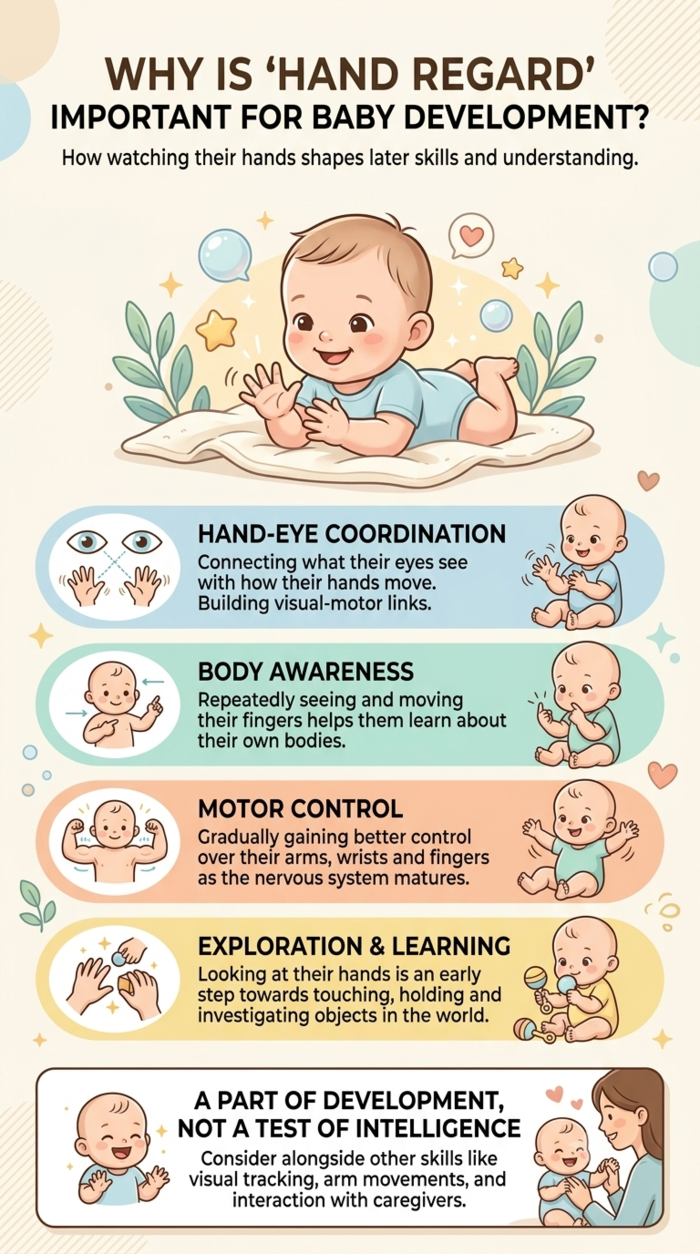
Watching their hands helps babies practise several skills that support later development.- Hand-eye coordination: Babies begin connecting what their eyes see with how their hands move.
- Body awareness: Repeatedly seeing and moving their fingers helps them learn about their own bodies.
- Motor control: As their nervous system matures, babies gradually gain better control over their arms, wrists and fingers.
- Exploration and learning: Looking at their hands is an early step towards touching, holding and investigating objects.
How Can Parents Support Hand Discovery at Home
Parents do not need special toys or equipment to support this milestone. Simple activities during everyday interactions can give babies opportunities to observe their hands.- Place your baby on their back on a clean cotton sheet during awake time.
- Let your baby move their arms and open and close their fingers without restrictive clothing or mittens when these are not needed for warmth.
- Hold a small toy a short distance above the chest so the baby can reach for it.
- Hold your baby at a comfortable distance and talk, smile, or sing.
- Put a rattle in your baby's hand and help them shake it.
- Place a baby-safe mirror within view.
- Keep their hands clean and avoid small objects, loose parts and choking hazards.
When to Talk to a Paediatrician
Raise concerns at routine immunisation visits or sooner if:- Your baby does not bring hands to the mouth by 2 months.
- Your baby does not bring things to the mouth by 4 months.
- Hand regard is absent, or persists well beyond 20 weeks. Either can signal developmental delay, and persistent hand regard can also occur in blind children.
- The eyes do not work together by 3 months.
- Your baby has lost skills they once had.
Whether you’re pregnant, a new mom, or navigating postpartum, you don’t have to do it alone. Join our support group to connect, share, and support one another.
FAQs on Hand Regard in Babies: When Do Infants Start Noticing Their Hands?
- Does hand regard mean my baby is developing normally?
Hand regard is one useful sign of emerging visual attention and coordination, but it cannot establish overall developmental health on its own. Doctors assess it alongside other age-appropriate milestones. - Is it normal for a baby to stare at their hands?
Yes. It is a normal stage of development that helps with eye-hand coordination and usually fades by 5 months.