
In this article:
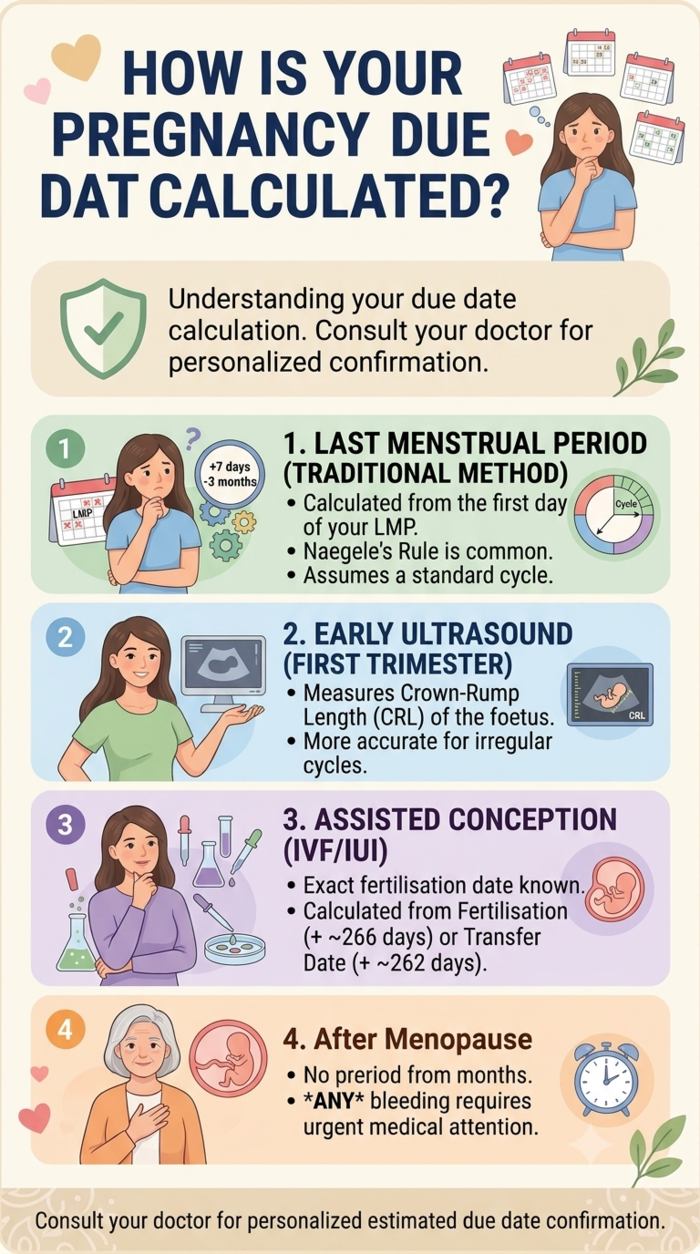
How Is Your Pregnancy Due Date Calculated?
The traditional method uses the first day of your last menstrual period. The standard method is Naegele's rule: add seven days to the first day of your LMP, then count back three months (or add 280 days). This assumes a 28-day menstrual cycle with ovulation on day 14.This method works best when:
- You remember the first day of your last period accurately.
- Your menstrual cycles are regular.
- Ovulation occurred at around the expected time.
For pregnancies conceived through IUI or IVF, the exact fertilisation date is known; doctors typically add 266 days to the ovulation or insemination date, or 261–263 days from an embryo transfer.
Is an Early Pregnancy Ultrasound More Accurate?
Early pregnancy ultrasound is one of the most reliable ways to establish gestational age, especially when the menstrual dates are uncertain.During a dating scan, the ultrasound specialist measures the developing baby and uses these measurements to estimate how many weeks pregnant you are and calculate the estimated date of delivery (EDD).
Why Do Due Dates Change During Pregnancy?
It is common for the date calculated from your period and the date estimated by ultrasound to differ by several days.An ultrasound done before 14 weeks narrows this margin to about five to seven days, because it measures the foetus directly rather than relying on menstrual history. Once a reliable gestational age has been established, repeated later scans are primarily used to assess your baby's growth, anatomy, placenta, amniotic fluid and other aspects of pregnancy.
The American College of Obstetricians and Gynecologists (ACOG) recommends using the ultrasound date over the LMP date when the two differ by more than seven days in the first trimester.
Changes will happen during the pregnancy, and the due date will not have much power in changing the final date. It is vital for women to carry on with the prenatal checkups, keep track of the movements of their babies, and adhere to the advice of their doctor.
What Is a Normal Range For Delivery?
A full-term pregnancy lasts anywhere from 37 to 42 completed weeks. Babies born between 37 and 39 weeks are termed "early term," those between 39 and 41 weeks "full term," and those after 41 weeks "late term."Around 90% of babies are born within this five-week window centred on the due date. If a pregnancy continues past 41 weeks, doctors monitor the mother and baby more closely, since post-term pregnancies carry additional risks that need tracking.
Can Your Due Date Be Wrong?
A due date is an estimate, not a prediction of the exact day of birth. Even when pregnancy dating is accurate, the onset of labour usually can't be predicted precisely. Your baby may arrive before or after the estimated date.Your maternity team uses gestational age to decide when important tests and scans should be performed and to assess whether a pregnancy is preterm, term or post-term.
Treat your due date as the midpoint of a five-week window rather than a fixed deadline, and rely on an early ultrasound for the most dependable estimate.
FAQs on How Accurate Is Your Due Date?
- Can my due date change after the first scan?
It can shift slightly if a first-trimester scan shows a different gestational age than the LMP calculation, but it is unlikely to change again after that point unless a large discrepancy appears later. - Is a due date from LMP or ultrasound more accurate?
An early ultrasound, done before 14 weeks, is more accurate than LMP-based dating, especially for women with irregular cycles. - What if my baby is not born by the due date?
This is common, since only a small percentage of babies arrive exactly on time. Doctors typically monitor mother and baby more closely if the pregnancy crosses 41 weeks.