
Understanding the difference between normal pregnancy-related leukocytosis and an abnormally high WBC count can help you know when further evaluation is needed.
For expert guidance on this topic, we spoke with Dr Ritambhara Bhalla, Associate Director, Department of Gynaecology, Cloudnine Group of Hospitals, Chandigarh.
What Is Leukocytosis?
Leukocytosis means your white blood cell (WBC) count is higher than the normal range. White blood cells help protect your body by fighting infections and supporting your immune system.During pregnancy, it is common for the WBC count to rise as your body naturally adapts to support your health and your baby's development.
"A high WBC count during pregnancy is often a normal physiological change and should always be interpreted in the context of the woman's pregnancy stage and overall health."
- Dr Ritambhara Bhalla, Associate Director - Department of Gynaecology at Cloudnine Group of Hospitals, Chandigarh
Normal White Blood Cell (WBC) Count During Pregnancy
A 2024 study published in BMC Pregnancy and Childbirth found that white blood cell (WBC) counts increase rapidly during the first 7 weeks of pregnancy and then remain relatively stable until delivery.Based on these findings, the researchers proposed the following reference ranges for different stages of early pregnancy.
| Weeks of Pregnancy | Normal WBC Count (×10⁹/L) |
| Up to 2 weeks | 4.0–10.0 |
| 3–5 weeks | 4.7–11.9 |
| 6 weeks until delivery | 5.7–14.4 |
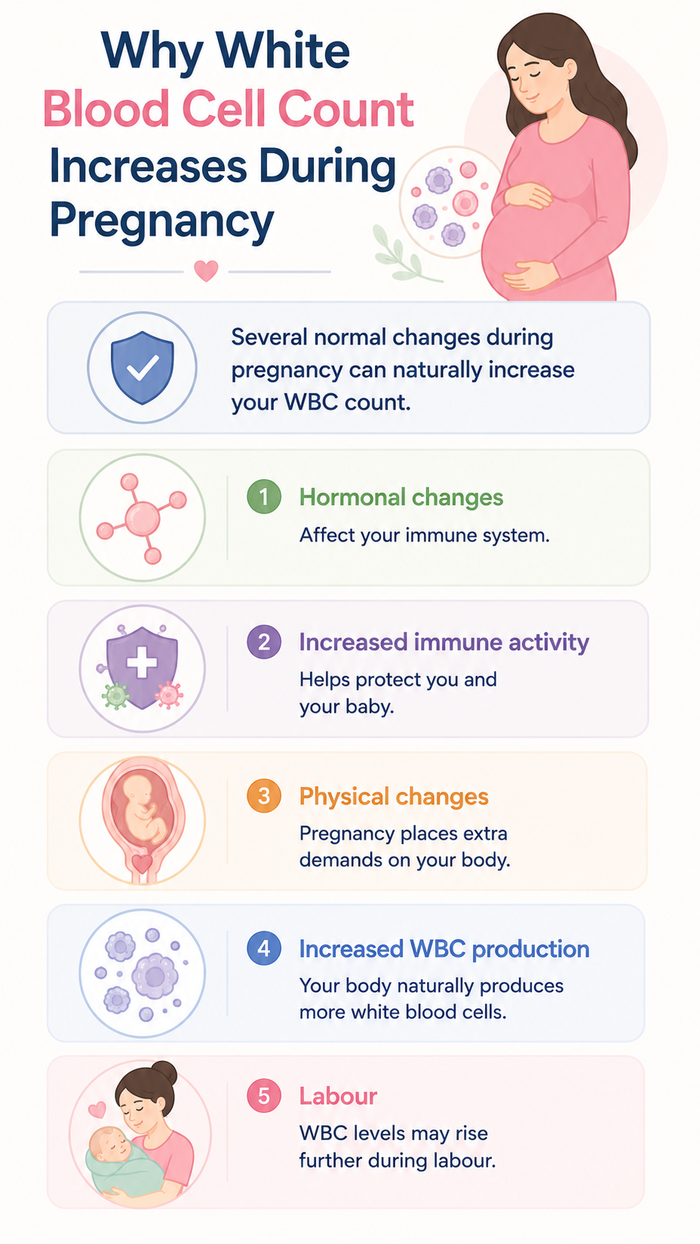
Why White Blood Cell Count Increases During Pregnancy
Several normal changes during pregnancy can naturally increase your WBC count.- Hormonal changes: Affect your immune system.
- Increased immune activity: Helps protect you and your baby.
- Physical changes: Pregnancy places extra demands on your body.
- Increased WBC production: Your body naturally produces more white blood cells.
- Labour: WBC levels may rise further during labour.
When a High WBC Count Is Not Normal
A high WBC count is not always normal and may sometimes be caused by an underlying medical condition, such as:- Urinary tract infection (UTI): A common cause of raised WBC levels during pregnancy.
- Respiratory infections: Such as bronchitis or pneumonia.
- Chorioamnionitis: An infection of the membranes surrounding the baby.
- Viral illnesses: Certain viral infections can increase WBC counts.
- Appendicitis: Inflammation of the appendix.
- Inflammatory conditions: Such as autoimmune disorders.
- Corticosteroid medications: Some steroid medicines can temporarily raise WBC levels.
- Rare blood disorders: Including leukaemia and myeloproliferative disorders.
Symptoms That May Suggest an Underlying Problem
A high WBC count alone does not always cause symptoms. However, if it is linked to an infection or another medical condition, you may notice:- Fever or chills
- Burning or pain while urinating
- Persistent cough or difficulty breathing
- Severe abdominal or pelvic pain
- Foul-smelling vaginal discharge
- Rapid heartbeat
- Feeling unusually weak or unwell
How Is Pregnancy Leukocytosis Evaluated?
Dr Ritambhara Bhalla recommends evaluating a high WBC count during pregnancy along with your symptoms, medical history, and other test results to determine whether it is a normal pregnancy change or a sign of an underlying condition.Among the tests that may be recommended are:
- Complete blood count (CBC) with differential
- Physical examination
- Urine analysis and urine culture
- Blood tests for infection or inflammation, if needed
- CRP or other inflammatory markers
- Ultrasound or additional investigations if infection is suspected
Treatment for Pregnancy Leukocytosis
In most cases, pregnancy leukocytosis is a normal change and does not require treatment. If a high WBC count is caused by an infection or another medical condition, your doctor may treat the underlying cause rather than the WBC count itself.- If it is a normal pregnancy change: No treatment is usually needed. Regular prenatal check-ups are enough.
- If it is caused by an underlying condition: Your doctor may recommend antibiotics, antiviral medicines, or other treatments based on the diagnosis.
When to See Your Doctor
Speak to your doctor if:- Your WBC count is higher than the normal range for your stage of pregnancy
- You develop any warning signs, such as fever, chills, or painful urination
- You have a high WBC count along with feeling generally unwell
- Your symptoms do not improve or become worse
- You are worried about your blood test results or your pregnancy
Whether you’re pregnant, a new mom, or navigating postpartum, you don’t have to do it alone. Join our support group to connect, share, and support one another.
FAQs on Pregnancy Leukocytosis: When Is a High White Blood Cell (WBC) Count Normal?
- Can a high white blood cell count harm my baby?
No. A normal pregnancy-related increase in WBC count does not harm your baby. However, the underlying cause should be treated if it is due to an infection. - When should I repeat my CBC if my WBC count is high?
Your doctor decides when to repeat your CBC based on your WBC level, symptoms, and stage of pregnancy. Do not repeat the test without medical advice. - Can stress increase WBC levels during pregnancy?
Yes. Physical or emotional stress can temporarily increase WBC levels.