In this article:
What Is Thalassaemia Carrier Screening?
Thalassaemia is an inherited blood disorder in which the body produces insufficient or abnormal haemoglobin, the protein that carries oxygen in red blood cells.Thalassaemia is passed on through genes. A carrier (thalassaemia trait or minor) has one changed gene and usually has no symptoms beyond mild anaemia.
If both parents carry compatible thalassaemia gene changes, their child may inherit a severe form of the condition, such as beta-thalassaemia major.
Who Should Get Tested for Thalassaemia Before and During Pregnancy?
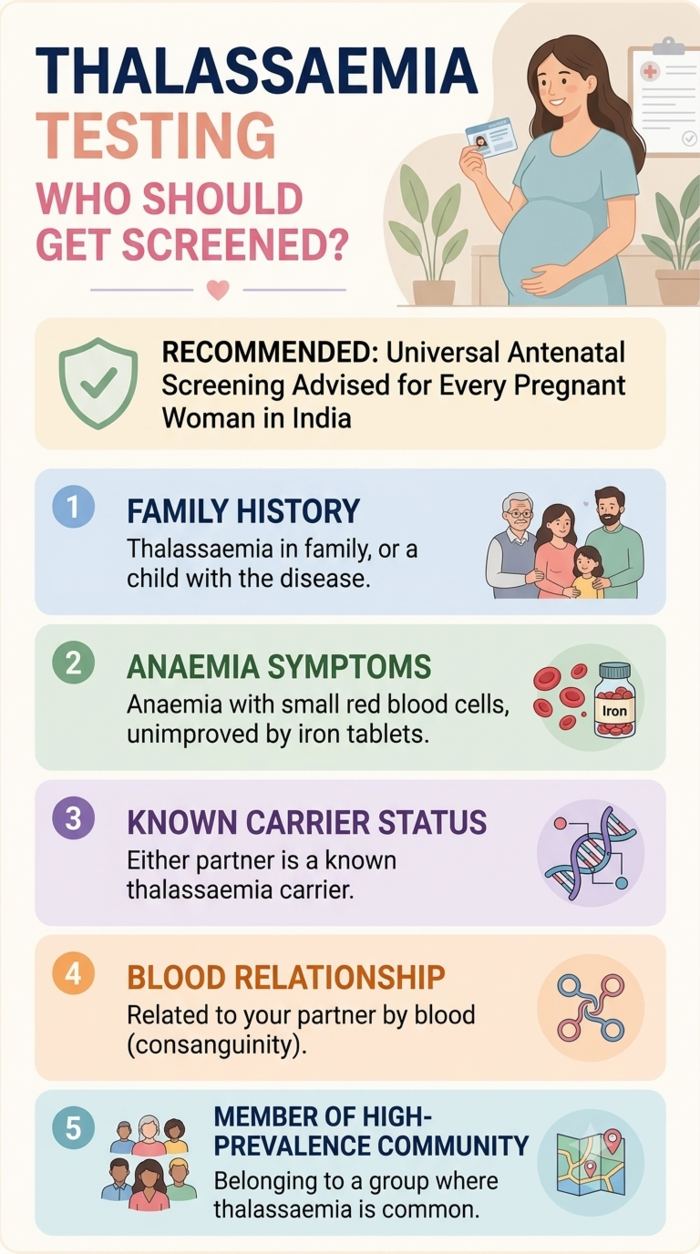
FOGSI’s 2025 recommendations advise universal antenatal screening in India for every pregnant woman. Testing is especially important if:- You or your partner has a family history of thalassaemia or a child with the disease
- You have anaemia with small red blood cells that does not improve with iron tablets
- You or your partner is a known carrier
- You are related to your partner by blood
- You belong to a community where thalassaemia is more prevalent
When Should Thalassaemia Screening Be Done?
The best time is before conception because it gives couples more time to understand their results and consider available options.Early testing is important because if the mother is a carrier, her partner will need testing. If both carry relevant gene changes, further investigations may be offered to determine whether the baby has inherited the condition.
The NHS recommends screening ideally before 10 weeks of pregnancy, allowing time for further testing and counselling if required.
Which Tests Are Used to Screen for Thalassaemia?
Three tests are commonly used in India:- Complete blood count (CBC): This test measures haemoglobin levels, red blood cell size, and other blood components. People with thalassaemia trait may have smaller-than-normal red blood cells (low mean corpuscular volume or MCV) and reduced mean corpuscular haemoglobin (MCH).
- NESTROFT: A simple, low-cost test that checks how easily red blood cells break in a salt solution. It is used as a first check, but it can miss some carriers. Every positive result needs confirmation with an HPLC test.
- Haemoglobin high-performance liquid chromatography (HPLC): FOGSI recommends HPLC as the preferred antenatal screening method. It measures haemoglobin A2, which is raised in beta-thalassaemia carriers.
Ideally, screening should happen before pregnancy, allowing more time to understand reproductive choices. However, testing during antenatal care can still provide valuable information. Early identification supports informed decisions, appropriate prenatal care, and preparation for a baby's medical needs.
What Happens If Both Partners Are Carriers?
If both parents are carriers, each pregnancy has:- a 25% chance of a baby with thalassaemia major
- a 50% chance of a carrier baby
- a 25% chance of an unaffected baby
Couples planning a pregnancy can also ask about IVF with preimplantation genetic testing (PGT), where embryos are tested before transfer so that only unaffected embryos are used.
Can Thalassaemia Be Detected in the Baby Before Birth?
If both parents carry relevant gene changes, doctors can offer prenatal diagnostic tests to determine whether the baby has inherited thalassaemia.- Chorionic villus sampling (CVS): A placental sample taken at 10 to 13 weeks to examine the baby's genetic material.
- Amniocentesis: A sample of amniotic fluid taken at 15 to 20 weeks and tested for the relevant genetic changes.
Thalassaemia screening before or early in pregnancy helps identify carrier couples, assess the risk to their baby, and explore reproductive options with appropriate medical guidance.
FAQs on Thalassaemia Screening Before and During Pregnancy: Who Needs It and Why
- Is thalassaemia screening compulsory in pregnancy in India?
No law makes it compulsory, but FOGSI recommends it for every pregnant woman. - Can iron tablets cure thalassaemia trait?
No. Trait is a genetic condition, not an iron deficiency. Iron is given only if tests show you are also iron deficient. - If I am a carrier, will my baby have thalassaemia?
Not necessarily. The baby can have thalassaemia major only if the father is also a carrier or has another haemoglobin variant.