We reached out to Dr Reema Poyil Kunhammed, Sr. Consultant – Obstetrics & Gynaecology, Kinder Hospitals Kochi, for a clinical perspective on this.
What Is Menstrual Migraine?
Menstrual migraine affects about 4–8% of women of reproductive age and 20–25% of women who have migraine.The International Classification of Headache Disorders (ICHD-3) describes two types:
- Pure menstrual migraine: Attacks occur only from two days before to three days after the start of bleeding, in at least two of three cycles.
- Menstrually related migraine: Attacks occur in that window and at other times of the cycle.
Why Does Your Period Trigger Migraine?
Oestrogen influences pain pathways and brain chemicals such as serotonin. Its level rises before ovulation and drops sharply before menstruation.In sensitive women, this fall lowers the threshold for a migraine attack. Progesterone also falls at this time, but its role is less clear. A family history of migraine raises the risk.
Hormonal fluctuations can also affect migraine patterns during puberty, after childbirth, during perimenopause, and when using certain hormonal contraceptives.
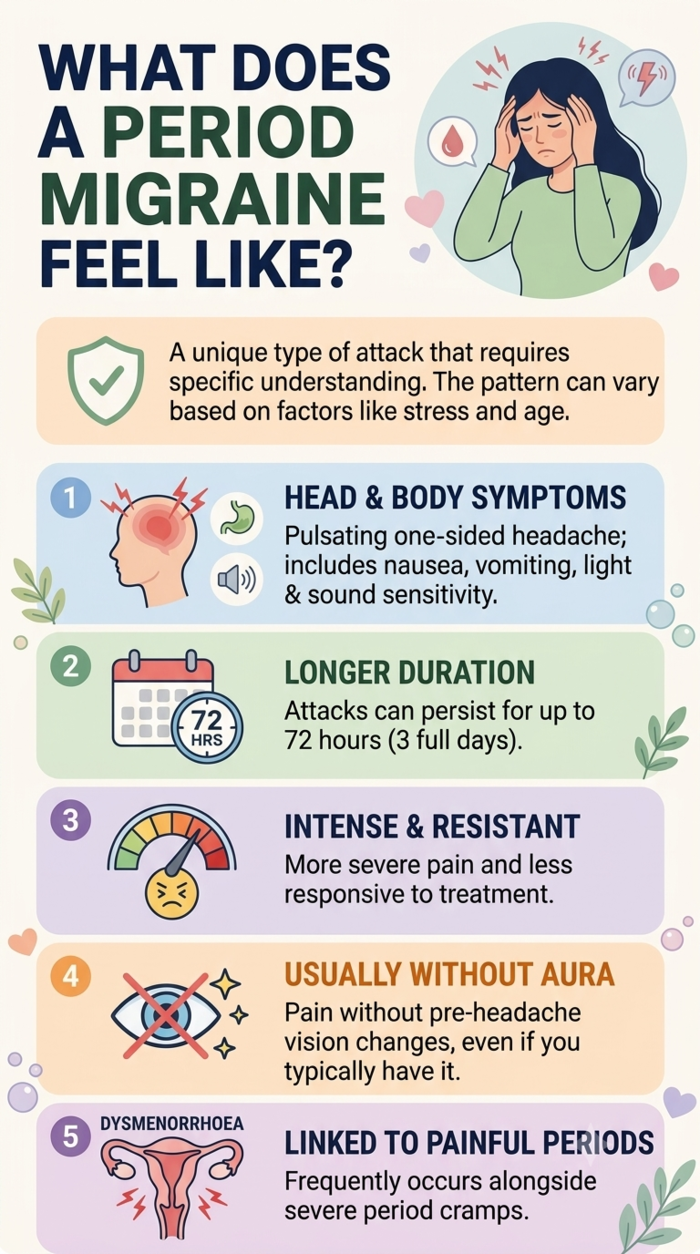
What Does a Period Migraine Feel Like?
Symptoms match other migraines: throbbing or pulsating, often one-sided headache, nausea, vomiting, sensitivity to light, smells, and sound, and pain that becomes worse with routine physical activity.Menstrual attacks differ in some ways:
- They last longer, sometimes up to 72 hours.
- They are more severe and respond less well to treatment.
- They usually occur without aura, even in women who have aura at other times.
- They often occur alongside painful periods (dysmenorrhoea).
Hormonal changes are not necessarily the only factor. During the menstrual period, some women also experience changes in sleep pattern, appetite, hydration, caffeine intake, stress levels, or blood sugar. Heavy menstrual bleeding and related iron deficiency may also contribute to headaches in some women.
What Other Factors Can Trigger Migraine?
The fall in oestrogen is an important trigger, but it may not be the only one. Around menstruation, some women also experience changes in sleep, meals, hydration, caffeine intake, and stress.Period pain itself can add to the overall burden. These factors may lower the threshold for a migraine in someone who is already sensitive to hormonal changes.
Practical factors such as long working hours, irregular meals, inadequate water intake, heat exposure, and changes in sleep schedules may also coincide with the menstrual period. These are not specific causes of menstrual migraine, but managing them can help reduce additional migraine triggers.
How Is Menstrual Migraine Diagnosed?
No single blood test confirms menstrual migraine. Doctors usually look at the timing, symptoms, and pattern of attacks.A headache and menstrual-cycle diary can be particularly useful. Record:
- The first and last day of each period
- When the headache begins
- How long it lasts
- Pain intensity
- Nausea, vomiting, or light sensitivity
- Medicines taken and how well they work
- Other possible triggers such as poor sleep or missed meals
Menstrual Migraine Treatment and Prevention
Treatment depends on how often the migraine occurs, how severe it is, and whether attacks happen outside the menstrual period.- During an attack: A doctor may recommend anti-inflammatory painkillers.
- Short-term prevention: For regular cycles, a doctor may advise starting a long-acting anti-inflammatory two days before the expected period, for about five to six days.
- Hormonal options: These include continuous use of a combined contraceptive pill without the placebo break, or an oestrogen gel or patch around menstruation. Doctors usually avoid oestrogen-containing methods in migraine with aura because of stroke risk.
- Daily habits: Regular meals, steady sleep, enough water, and stress control reduce other triggers. A preventive plan needs at least three cycles to judge.
You’re not alone in your journey when trying to conceive. Join our supportive community to connect with others, share experiences, and find encouragement every step of the way.
FAQs on Why Do Some Women Get Migraines Only During Their Period?
- Can migraine occur only during periods?
Yes. This is pure menstrual migraine, but it is rare. Most women with menstrual migraine also have attacks at other times. - How long does a menstrual migraine last?
Menstrual attacks often last longer than other migraines, sometimes up to 72 hours. - Do period migraines stop after menopause?
Migraines become less common after menopause. Perimenopause can worsen them because oestrogen levels fluctuate.