What Is Entonox?
Entonox is a blend of two gaseous substances, nitrous oxide and oxygen, equally distributed. It is also known as "gas and air" or "laughing gas". Entonox is an odourless substance with no colour; it is inhaled with the use of a mouthpiece or a self-administered mask.It has been used for pain relief in childbirth for years. Entonox is the most commonly used method of pain relief in hospitals now. In contrast to some other types of pain relief, it does not have to be administered by an anaesthetist and has no lasting effect on your body.
How Is Entonox Used for Pain Relief During Labour?
You are in control of the Entonox throughout the entire process. Your doctor will teach you how to hold the mouthpiece or mask and will instruct you on the most efficient usage of it.The effects of the gas appear after 15 to 20 seconds of using it; thus, the timing is very important. The procedure is most effective if you start inhaling the gas exactly at the beginning of each contraction, which would ensure that the gas starts taking effect when the pain peak is reached. When there are no contractions, you just breathe normally.
Entonox may be used anytime during established labour and anywhere (at home, birthing pool, hospital). In case you have decided to have a baby at home, your doctor will organise the necessary equipment for it.
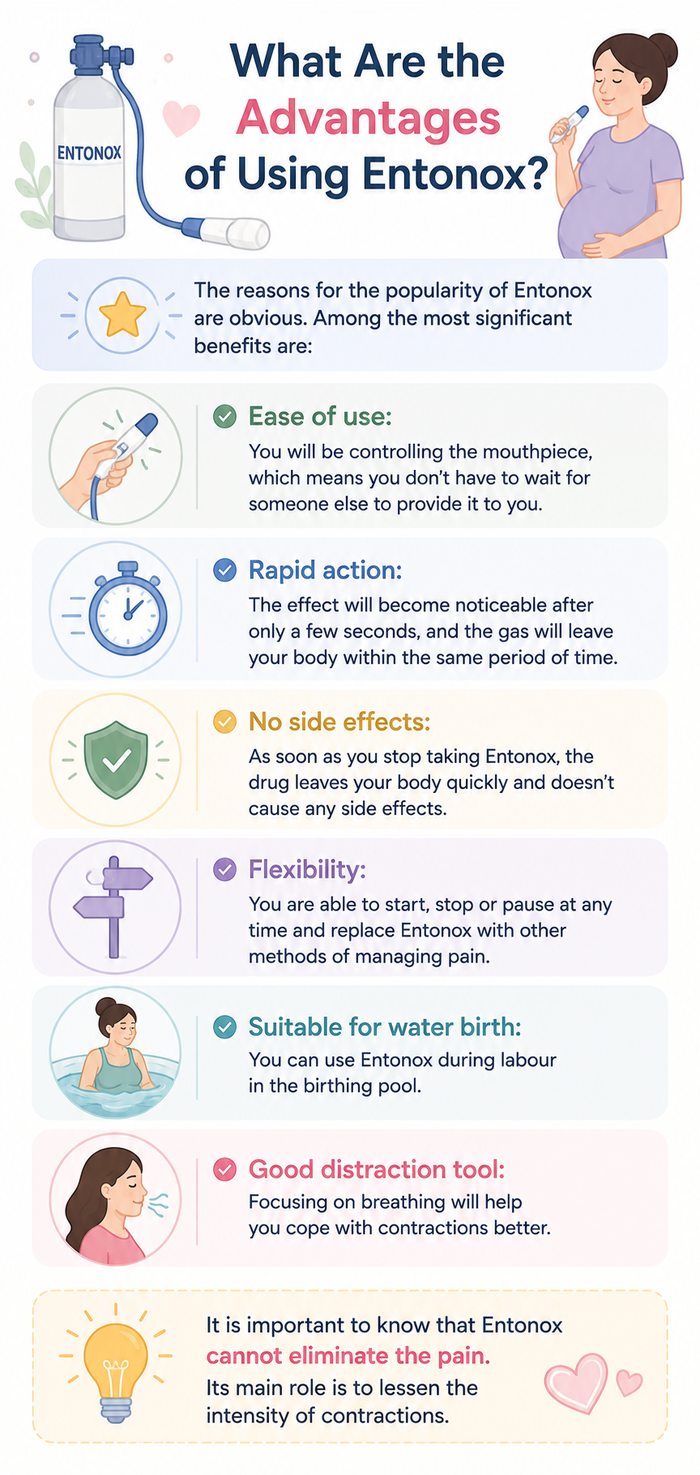
What Are the Advantages of Using Entonox?
The reasons for the popularity of Entonox are obvious. Among the most significant benefits are:- Ease of use: You will be controlling the mouthpiece, which means you don’t have to wait for someone else to provide it to you.
- Rapid action: The effect will become noticeable after only a few seconds, and the gas will leave your body within the same period of time.
- No side effects: As soon as you stop taking Entonox, the drug leaves your body quickly and doesn’t cause any side effects.
- Flexibility: You are able to start, stop or pause at any time and replace Entonox with other methods of managing pain.
- Suitable for water birth: You can use Entonox during labour in the birthing pool.
- Good distraction tool: Focusing on breathing will help you cope with contractions better.
What Are the Side Effects of Entonox?
Like any other method of pain relief, Entonox is not without its side effects. However, most of these effects are mild and disappear shortly after discontinuation. Some of these effects include:- Feeling dizzy and lightheaded
- Dry mouth
- Nausea
- Feeling sleepy
- Tingling sensation
Is Entonox Safe for You and Your Baby?
Entonox is a safe choice for childbirth if used properly. It does not require the close medical supervision that is required for other ways of pain relief and does not have any negative effects on your baby. The increased concentration of oxygen that you inhale along with the nitrous oxide is also regarded as beneficial for both of you during childbirth.Is Entonox Sufficient for Pain Relief for Everyone?
For some women, Entonox offers sufficient pain relief to allow them to give birth. However, for others, Entonox may work in the early stage but then require a stronger type of pain relief, such as an epidural or any other. There is absolutely nothing wrong with any feelings. If you think that Entonox does not offer sufficient pain relief, discuss it with your doctor.When Should You Contact Your Doctor?
Entonox is thought to be appropriate for the majority of women in labour; however, it is always a good idea to talk about pain relief in advance, particularly if you have one of the following situations:- You suffer from a pre-existing health problem such as heart or lung disease
- You are uncertain about whether Entonox is appropriate for you, taking into account where you will give birth
- You want to know how Entonox can work alongside other forms of pain relief
- You have previously used Entonox and have had a side effect that worried you
- You would like more information about your pain relief options
Pain management is unpredictable, and, understandably, you wish to be aware of your choices before the big day. Entonox is an easy-to-use type of pain relief and is entirely under your control, and understanding how Entonox works can help you feel more prepared for when your baby is born.
Whether you’re pregnant, a new mom, or navigating postpartum, you don’t have to do it alone. Join our support group to connect, share, and support one another.
FAQs on Entonox During Labour: How Gas and Air Help With Pain Relief
- How soon does Entonox become effective?
This gas usually becomes effective within 15 to 20 seconds. Therefore, it is best used when you inhale it immediately after the start of a contraction. - Can Entonox be used with other pain relief methods?
Yes. Entonox may often be used in conjunction with certain pain relief methods. Your doctor will help you decide which combination works for you. - Will Entonox remain in my body after labour?
No. Entonox moves out of your body within minutes of discontinuing its use.