In this article:
How Do Twins Increase the Risk of Preterm Birth?
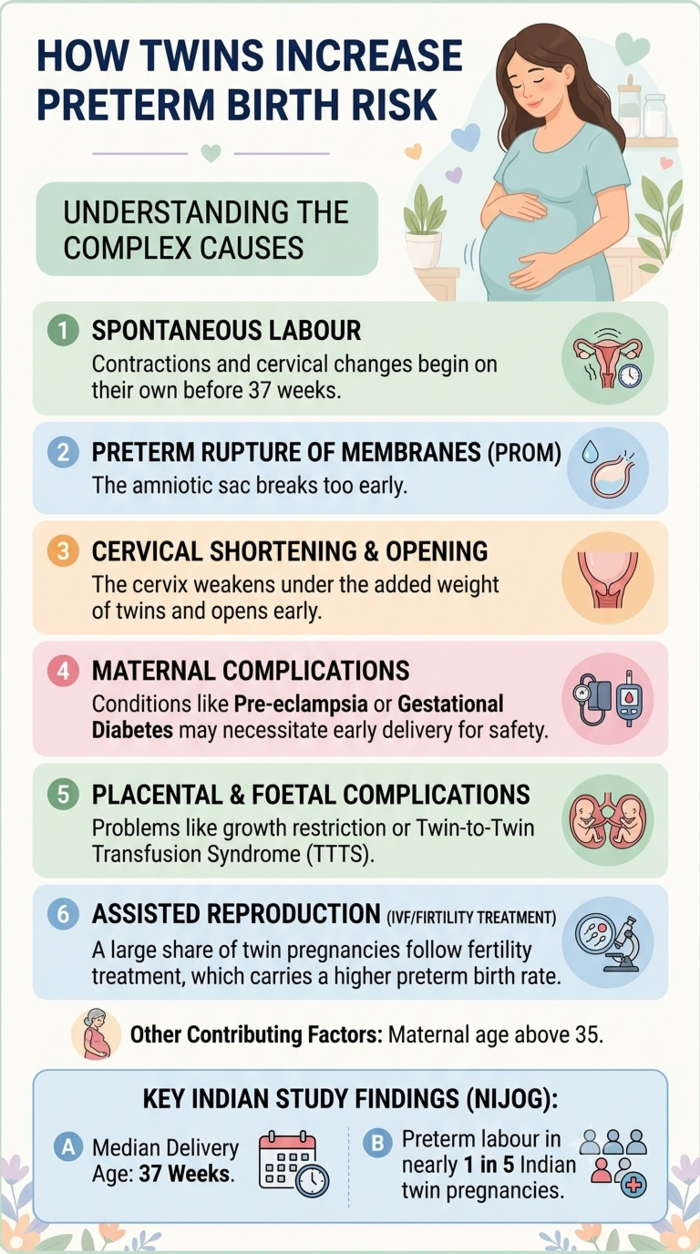
The uterus normally expands throughout pregnancy. With twins, it has to stretch further and accommodate more amniotic fluid and foetal tissue. This increased stretching may contribute to cervical changes and uterine activity that can lead to labour. However, uterine stretching is only one part of the explanation.Twin pregnancies may end early because of:
- Spontaneous labour: When contractions and cervical changes begin on their own before 37 weeks.
- Preterm rupture of membranes: When the amniotic sac breaks before 37 weeks.
- Cervical shortening or opening: When the cervix weakens under the added weight of twins and begins to open before labour is due.
- Maternal complications: Such as gestational diabetes and pre-eclampsia, where high blood pressure in the mother can make early delivery safer than continuing the pregnancy.
- Foetal complications: Including growth restriction or abnormal blood flow.
- Placental complications: Particularly twin-to-twin transfusion syndrome in monochorionic twins (twins sharing one placenta), where uneven blood flow between the babies can trigger early delivery.
- Pregnancy through IVF or ovulation induction: A large share of twin pregnancies follow fertility treatment, which itself carries a higher preterm birth rate.
- Maternal age above 35: As more women conceive twins later through assisted reproduction.
"Twin pregnancies are more likely to deliver early because carrying two babies puts greater pressure and stretching on the uterus, and the body may naturally respond by starting labour earlier."
Dr Soumya Lakshmi, Sr. Consultant, Obs & Gyn, Aster CMI Hospital
How Early Can Twins Be Delivered Safely?
The timing depends on whether the babies have separate or shared placentas, whether they share an amniotic sac, foetal growth, maternal health, and other complications.NICE guidance recommends planned birth around 37 weeks for uncomplicated twins with separate placentas and around 36 weeks for twins sharing a placenta, while monoamniotic twins may require substantially earlier planned delivery.
A planned birth at 36 or 37 weeks should not automatically be described as an unexpected premature delivery.
Can Preterm Birth in Twin Pregnancy Be Prevented?
Regular antenatal monitoring helps doctors identify problems before they become emergencies. Depending on the type of twins, monitoring may include:- Ultrasound scans to assess foetal growth and amniotic fluid
- Doppler studies to assess blood flow when indicated
- Assessment of cervical length in selected women
- Blood pressure and urine checks for pre-eclampsia
- More frequent surveillance for twins sharing a placenta
- Foetal monitoring later in pregnancy when clinically indicated
- Correcting anaemia with iron and folic acid supplementation
How Common Are Twin Pregnancies in India?
Twin pregnancies occur in about 9 to 16 out of every 1,000 births in India, and this number has been rising with wider use of fertility treatment. Studies also show that close to 45% of twin pregnancies end in preterm delivery, making early antenatal planning essential rather than optional for anyone expecting twins.Twin pregnancies are more likely to deliver early because of the physical and placental demands. Regular antenatal monitoring remains the main way to manage this risk and support a safe delivery for both.
Whether you’re pregnant, a new mom, or navigating postpartum, you don’t have to do it alone. Join our support group to connect, share, and support one another.
FAQs on Why Are Twin Pregnancies More Likely to Deliver Early?
- Is it normal for twins to be born early?
Yes. Most twin pregnancies deliver between 35 and 37 weeks, which is considered normal, not a complication on its own. - Can a twin pregnancy go full term?
It can, though it is uncommon. Full term for twins is generally considered 37 weeks, earlier than the 39 to 40 weeks used for a single baby. - What are the warning signs of preterm labour in a twin pregnancy?
Regular contractions, lower back pain, pelvic pressure, and a change in vaginal discharge before 37 weeks should be reported to a doctor without delay.