
In this article:
What Causes Anovulation and Who Needs Ovulation Induction?
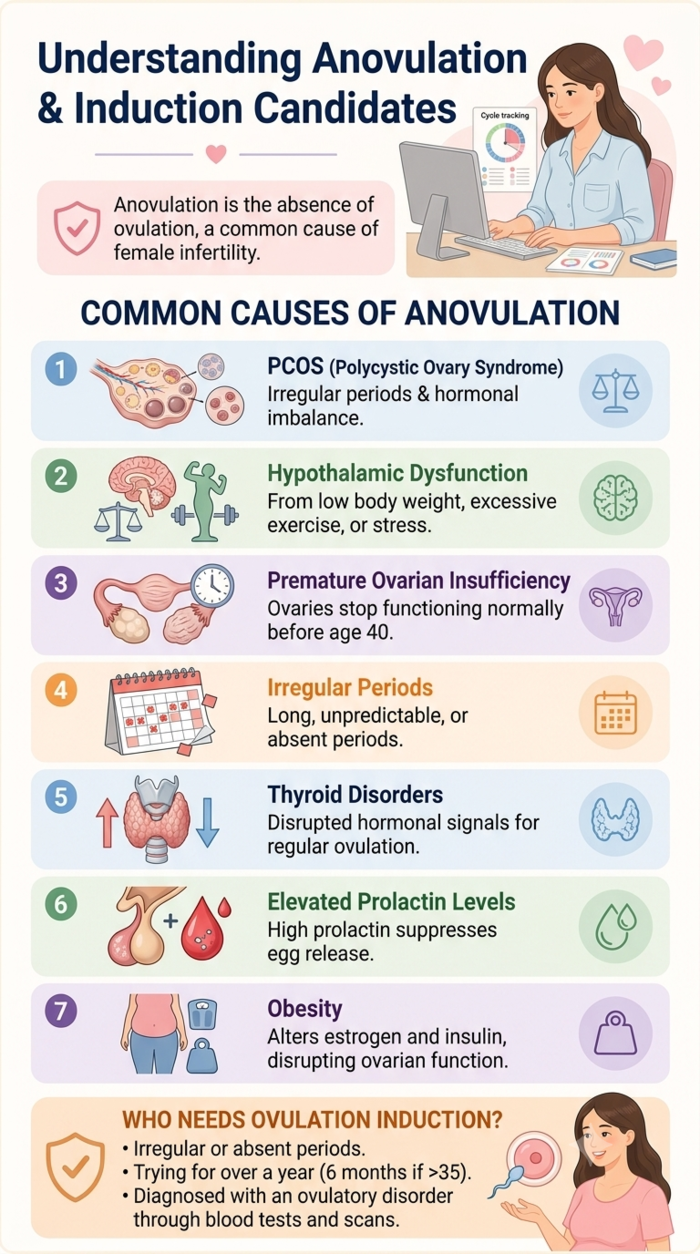
Anovulation is the absence of ovulation that accounts for a significant share of female infertility cases. Common causes include:- PCOS: Marked by irregular periods and hormonal imbalance.
- Hypothalamic dysfunction: Often linked to low body weight, excessive exercise, or stress.
- Premature ovarian insufficiency: The ovaries stop functioning normally before age 40, reducing egg release and hormone production.
- Irregular periods: Long, unpredictable, or absent periods may indicate that ovulation is not occurring regularly.
- Thyroid disorders: Both an underactive and overactive thyroid can disrupt the hormonal signals needed for regular ovulation.
- Elevated prolactin levels: High prolactin suppresses the hormones that trigger egg release, leading to irregular or absent ovulation.
- Obesity: Excess body fat alters oestrogen and insulin levels, which disrupts the hormonal balance the ovaries need to release an egg regularly.
How Does Ovulation Induction Work Step by Step?
The process begins with baseline blood tests and a pelvic ultrasound to assess ovarian reserve and rule out other causes of infertility. Once cleared, treatment usually follows this sequence:- Medication: Started early in the menstrual cycle, typically from day 2 to day 5.
- Monitoring: Transvaginal ultrasound tracks follicle size every few days.
- Trigger injection: Human chorionic gonadotropin (hCG) is given once a follicle reaches the right size, prompting egg release within 36 hours.
- Timed intercourse or IUI: This follows the trigger.
- Luteal phase support: Such as progesterone supplements, may be prescribed to support early pregnancy if conception occurs.
Ovulation induction is a procedure in fertility treatments that consists of using medications to give a boost to the ovary so that an egg is released. This treatment is often recommended for women who don't ovulate regularly or at all.
Which Medicines Are Used for Ovulation Induction?
Common ovulation-induction medicines include:- Letrozole: It is widely used for ovulation induction, particularly for women with PCOS and anovulatory infertility. Current international PCOS guidance recommends it over clomiphene when appropriate.
- Clomiphene citrate: This medicine stimulates the hormonal signals involved in follicle development and ovulation.
- Gonadotropins: These are injectable hormones, including FSH, that directly stimulate the ovaries. They may be considered when oral medicines do not work or for specific hormonal conditions.
What Are the Risks and Side Effects of Ovulation Induction?
Oral medicines can cause symptoms such as headache, nausea, hot flushes, abdominal discomfort, or mood changes.A key concern with ovarian stimulation is multiple pregnancy, particularly when several follicles develop. Injectable gonadotropins can also increase the risk of ovarian hyperstimulation syndrome (OHSS), in which the ovaries become enlarged and fluid can accumulate in the body.
Doctors may cancel a treatment cycle if too many follicles develop. Ovulation induction aims to achieve development of a single mature follicle while limiting the risk of multiple pregnancy.
Ovulation Induction in India: Success Rates, Cost and Accessibility
Success depends on age, the underlying cause of infertility, and how many cycles are attempted, typically three to six before reviewing the approach. With clomiphene or letrozole, ovulation is achieved in 70–80% of women with PCOS, and pregnancy rates average around 10–20% per cycle.Ovulation induction is widely available across fertility clinics with a treatment cycle costing between ₹3,000 and ₹15,000, depending on the medication and monitoring involved. Oral medications like letrozole and clomiphene are significantly more affordable than injectable gonadotropins.
Many fertility centres now combine ovulation induction with lifestyle counselling, addressing diet and weight management, given the high prevalence of PCOS-linked infertility among Indian women.
Ovulation induction offers a structured, monitored way to restore fertility for women with ovulation disorders, and for most, it is the starting point of a successful path to pregnancy.
You’re not alone in your journey when trying to conceive. Join our supportive community to connect with others, share experiences, and find encouragement every step of the way.
FAQs on Ovulation Induction: How It Works, Who Needs It and What to Expect
- How long does ovulation induction take to work?
Most women respond within one to three medicated cycles. If ovulation does not occur after three to six cycles, doctors typically reassess the treatment plan. - Is ovulation induction painful?
Oral medication causes minimal discomfort. Injectable gonadotropins may cause mild bloating or tenderness at the injection site, but the process itself is not painful.