
What Is the First Stage of Labour?
Labour process stage one begins after entering into established labour, where there is dilation of the cervix by means of contractions. Labour stage one ends once there is total cervical dilation. The first stage of labour is usually subdivided into the latent and established stages, when dilation is slow and rapid respectively. This stage is the longest of all three stages of labour and may last for many hours, particularly for first-time mothers.What Do Dilation and Effacement Mean?
Two main changes take place during this period. Understanding them can help you make sense of updates from your doctor.- Firstly, dilation means the degree of your cervical opening and is measured in centimetres, ranging from 0 (no dilation) to 10 (completely dilated). Dilation is the first sign used by doctors to measure the progress of labour.
- Secondly, effacement shows how much your cervix thins out. Before labour, the cervix is thick, similar to a closed door; however, during labour, it gradually becomes thinner, and this change is described in percentages from 0 to 100 per cent effacement.
- Thirdly, station describes how low in your pelvis your baby moved, and how close he or she is to birth, measured relative to a fixed point on your pelvic bones.
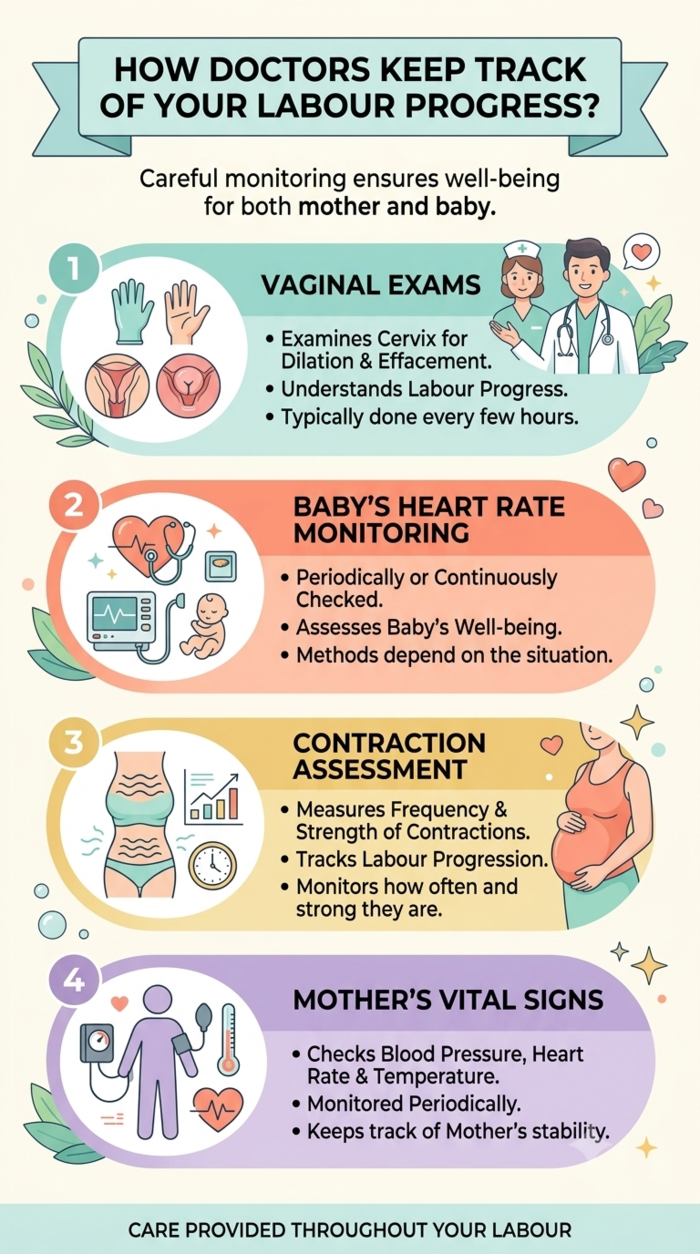
How Do Doctors Keep Track Of Your Progress?
As a matter of fact, your doctor monitors you and your baby during the entire course of this stage once you go into labour. Typically, this involves the following:- Vaginal exams: The cervix will be examined for dilation and effacement, usually done every few hours. This allows your doctor to understand how your labour proceeds and if something requires more attention.
- Monitoring of the heart rate of your baby: The heart rate of your baby is monitored periodically or continuously depending on the situation.
- Monitoring of your contractions: The contractions of your baby are monitored. This includes the measurement of their frequency and strength.
- Measurement of your vital signs: Your blood pressure, heart rate and body temperature are monitored periodically.
What Are Your Pain Relief Options?
No one method to relieve pain is better than others, and the possible pain relief choices are as follows:- Relaxation and breathing exercises: You can use drug-free and simple methods at the beginning of the first stage.
- Gas and air: The most common type of inhaler pain reliever administered under your own control.
- Injected pain relief: There are specific medications that can be injected in order to make contractions less painful temporarily.
- Epidural pain relief: A more advanced way to relieve pain via injection in the lower part of your back, providing numbness in the lower body parts.
When Should You Contact Your Doctor?
It is important to maintain contact with your doctor during this stage, and you should consider contacting them if you experience any of the following:- If you doubt that your labour has indeed been established
- If you feel your pain cannot be managed with your present pain relief method
- If you have any questions regarding your progression or your baby’s heartbeat
- If you feel uneasy and need reassurance of any sort
The first stage asks your body to do quiet, steady work long before you reach the moment of pushing. Trust the process and ask your questions freely; remember, each centimetre brings you closer to your baby.
Whether you’re pregnant, a new mom, or navigating postpartum, you don’t have to do it alone. Join our support group to connect, share, and support one another.
FAQs on First Stage of Labour: What To Expect During Childbirth?
- How frequently will my vaginal examination take place during the first stage?
Your vaginal examination would normally be conducted every few hours. - Would I have the freedom to choose what type of pain management I want?
Yes, you may always talk about your choices with your doctor and even change your mind anytime during labour if necessary. - How long is the first stage of labour going to take?
There is no set duration, although it is the longest of the three stages and could take many hours.