
When Do You Start Feeling Baby Movements?
Most women begin to feel their baby move between 16 and 24 weeks of pregnancy. First-time mothers often notice movement slightly later than those who have been pregnant before, since they may not yet recognise the sensation.Early movements feel like light flutters, bubbles or gentle taps rather than distinct kicks. By 24 weeks, these movements usually settle into a regular pattern, and the number of movements tends to increase until around 32 weeks. The baby may be more active at certain times, such as after meals or when you are resting.
After this point, movements should continue at a steady pace right through to delivery, including during early labour.
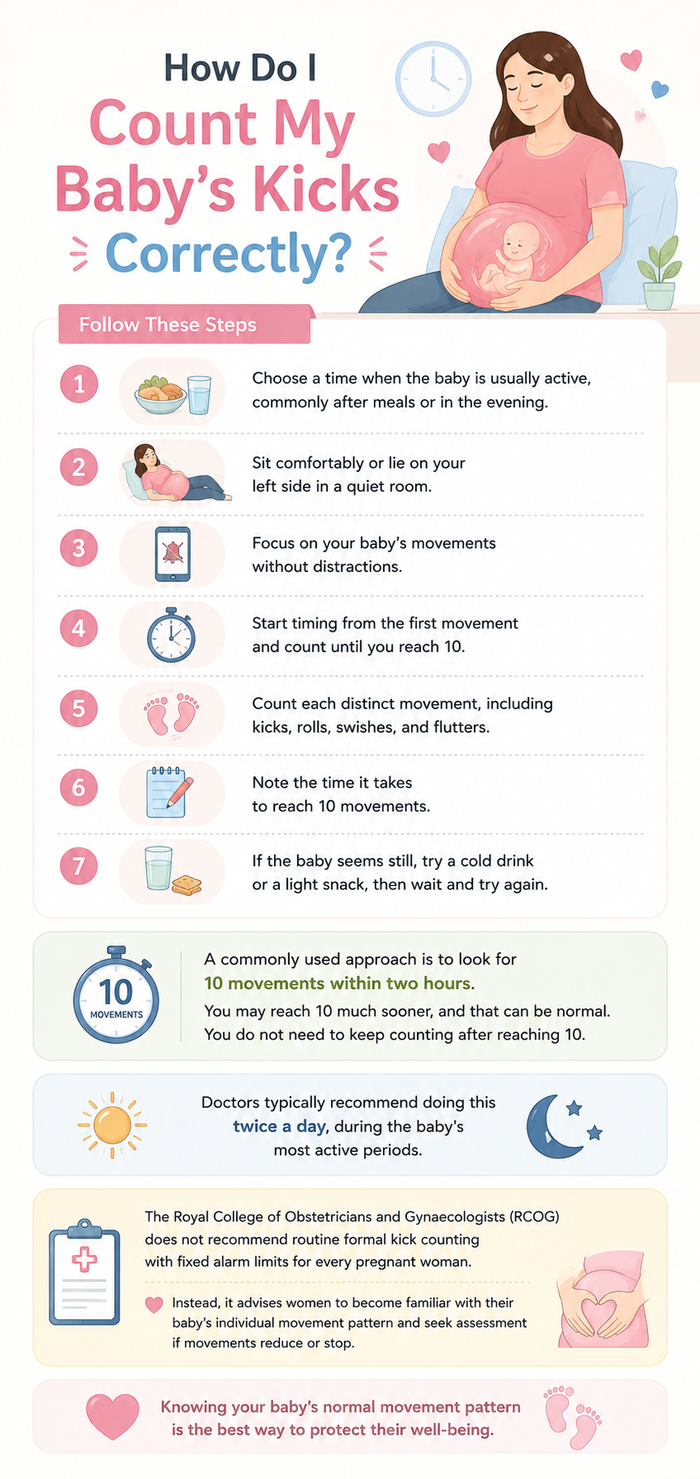
How Do I Count My Babys Kicks Correctly?
You can follow these steps:- Choose a time when the baby is usually active, commonly after meals or in the evening.
- Sit comfortably or lie on your left side in a quiet room.
- Focus on your baby's movements without distractions.
- Start timing from the first movement and count until you reach 10.
- Count each distinct movement, including kicks, rolls, swishes, and flutters.
- Note the time it takes to reach 10 movements.
- If the baby seems still, try a cold drink or a light snack, then wait and try again.
Doctors typically recommend doing this twice a day, during the baby's most active periods. However, current guidance is not completely uniform. The Royal College of Obstetricians and Gynaecologists (RCOG) does not recommend routine formal kick counting with fixed alarm limits for every pregnant woman. Instead, it advises women to become familiar with their baby's individual movement pattern and seek assessment if movements reduce or stop.
Is It Normal for Baby Movements to Change?
Foetal movements can vary throughout the day. Babies have periods of sleep and activity, and you may notice movements less when you are busy or physically active. You are often more aware of movement when sitting quietly or lying down.As pregnancy advances, the type of movement may change because your baby has less room to move around. However, this does not mean that your baby should stop moving or become consistently less active.
What If I Feel Fewer Than 10 Movements?
If fewer than 10 kicks are felt within two hours, mothers should contact their doctor or maternity unit. Maternal perception of reduced foetal movement affects a notable share of pregnancies, and while most such cases result in a normal outcome, reduced movement is also linked to a higher chance of the baby being small for gestational age, along with an increased risk of stillbirth.In India, where antenatal visit frequency can vary by region and access to care, learning to self-monitor movements gives mothers an additional layer of safety between check-ups.
Does Reduced Movement Always Mean a Serious Problem?
Not necessarily; most mothers who report reduced movements go on to have a normal pregnancy outcome. However, because reduced movement can occasionally signal a problem needing attention, every episode should be checked by a doctor rather than assumed to be harmless.Seek medical advice promptly if:
- Your baby's movements are noticeably less than usual.
- You cannot feel your baby moving when you normally would.
- The movement pattern has suddenly changed.
- You have concerns about your baby's activity, even if you are unsure whether the reduction is significant.
Whether you’re pregnant, a new mom, or navigating postpartum, you don’t have to do it alone. Join our support group to connect, share, and support one another.
FAQs on Foetal Kick Counts: How Many Movements Are Normal Each Day?
- At what week should I start counting kicks?
Most doctors recommend starting formal kick counts from around 28 weeks, once movements have settled into a regular pattern, though movements are usually first felt between 16 and 24 weeks. - Do babies move less at night?
No, many mothers notice more movement in the evening or at night, often because daytime activity makes movements harder to notice. - Should I worry if my baby is quieter than usual for one day?
A single quieter day is not unusual, but if you feel a genuine drop from your baby's normal pattern, or fewer than 10 movements in two hours, contact your doctor the same day rather than waiting for the next scheduled visit.